Healthcare organizations face a growing challenge. Patient expectations continue to rise, clinical workloads are increasing, and administrative responsibilities consume a significant portion of a provider’s day. While healthcare technology has evolved rapidly, many practices still rely on disconnected systems that require staff to manually move information from one workflow to another.
A patient appointment may begin in a scheduling platform, continue in an electronic health record, move through coding software, and eventually reach a billing system. Every handoff creates opportunities for delays, duplicate work, and missed information.
This is why healthcare workflow automation has become a priority for healthcare organizations across the United States.
Healthcare workflow automation is not simply about automating individual tasks. It is about connecting documentation, communication, coding, billing, and patient management into one continuous process that keeps care moving efficiently.
Platforms such as AllayAI HELIX are helping healthcare organizations reduce administrative burdens while improving operational efficiency across the entire patient journey.
What Is Healthcare Workflow Automation?
Healthcare workflow automation refers to the use of technology to streamline repetitive clinical and administrative processes. Instead of requiring staff to manually transfer information between systems, automation helps move information through the appropriate workflow automatically.
A traditional workflow often looks like this:
Patient Visit → Documentation → Coding → Claims → Billing → Payment
In many organizations, each stage requires manual intervention. Staff members review information, re-enter data, send follow-up emails, and manage multiple systems to complete a single patient encounter.
Healthcare workflow automation helps eliminate these unnecessary steps by creating connected workflows that allow information to move efficiently between departments and systems.
The goal is simple: reduce administrative effort while improving accuracy and visibility across the organization.
Why Healthcare Practices Need Workflow Automation
Administrative work remains one of the largest operational challenges in healthcare.
Providers often spend hours completing documentation after clinic hours. Billing teams review claims manually. Front-office staff manage appointment reminders, patient messages, and scheduling requests across multiple platforms.
While each task may only take a few minutes, the cumulative impact across hundreds of patients becomes substantial.
Healthcare automation software helps practices reduce repetitive tasks and create a more connected operational model. When workflows are connected, information only needs to be captured once and can then support multiple downstream processes.
This creates a more efficient experience for clinicians, administrative teams, and patients.
Documentation Is the Foundation of Every Workflow
Every healthcare workflow begins with clinical documentation.
If documentation is delayed, incomplete, or disconnected from other systems, the rest of the workflow slows down as well.
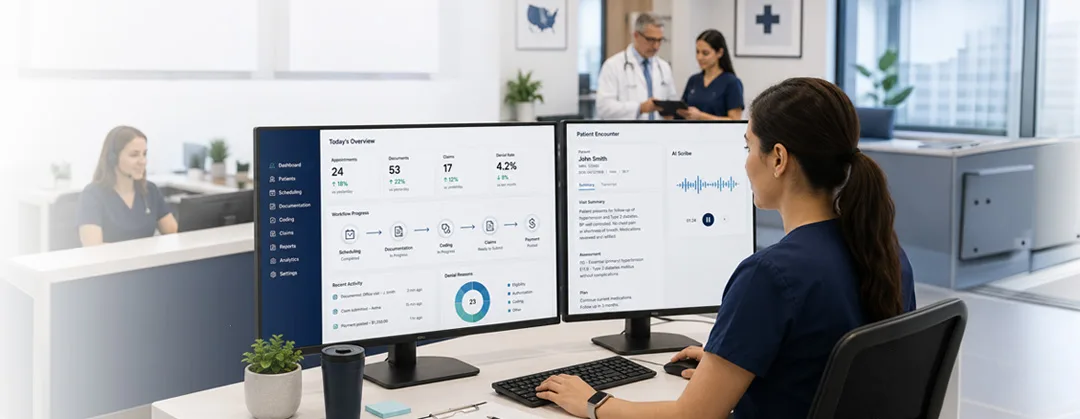
Modern organizations are increasingly adopting ambient AI scribe technology to capture clinical conversations in real time and generate structured documentation during the patient encounter.
With AllayAI HELIX, providers can focus on patient care while documentation is generated automatically in the background. Instead of spending hours completing notes after clinic hours, clinicians can review and finalize documentation immediately following the visit.
Because documentation serves as the starting point for coding, billing, and follow-up workflows, improving documentation efficiency often improves the entire healthcare workflow.
Communication Plays a Critical Role in Workflow Efficiency
Many workflow delays occur because of communication barriers.
Patients may miss instructions, fail to complete follow-up tasks, or struggle to communicate in their preferred language. Care teams may also spend valuable time coordinating information between providers and departments.
A modern healthcare communication platform helps solve these challenges by creating a more connected communication experience for both patients and providers.
AllayAI HELIX includes real-time medical translation capabilities that support multilingual patient interactions while automatically generating English clinical documentation. This helps healthcare organizations improve patient engagement while reducing communication-related delays.
Effective communication ensures that the right information reaches the right people at the right time, which is a critical component of healthcare workflow automation.
Why Coding and Billing Must Be Connected
Healthcare workflows do not end when documentation is complete.
The information captured during a patient encounter must continue into coding, claims management, and reimbursement workflows.
Many healthcare organizations still rely on disconnected systems that require coding teams to manually review documentation and search for relevant billing codes.
Modern medical coding software helps streamline this process by analyzing clinical documentation and recommending ICD-10-CM, CPT®, HCPCS, HCC, and modifier codes based on documented clinical information.
When documentation and coding operate within the same connected workflow, healthcare organizations can improve coding efficiency, reduce administrative work, and support cleaner claims submission.
This creates a smoother path from patient care to reimbursement.
Key Benefits of Healthcare Workflow Automation
Organizations that implement healthcare workflow automation often experience improvements across several operational areas.
Administrative teams spend less time moving information between systems. Providers spend less time completing documentation after hours. Coding and billing workflows become more efficient. Patient communication improves. Leadership gains better visibility into operational performance.
Most importantly, staff members can focus more attention on patient care instead of administrative processes.
Healthcare workflow automation is not about replacing healthcare professionals. It is about giving them better tools to work more efficiently.
What to Look for in Healthcare Workflow Automation Software
Healthcare organizations evaluating workflow automation solutions should look beyond individual features.
The most effective platforms function as a healthcare technology platform that connects multiple workflows rather than solving only one problem.
Important considerations include:
- Integration with existing EHR systems
- Workflow automation capabilities
- Clinical documentation support
- Communication tools
- Coding and billing integration
- Security and compliance standards
- Scalability for future growth
A connected healthcare platform creates greater value than a collection of disconnected software tools.
The Future of Healthcare Workflow Automation
Healthcare organizations are moving toward more connected and intelligent workflows.
Instead of managing documentation, communication, coding, and billing as separate functions, modern healthcare platforms are bringing these activities together within a unified workflow environment.
AllayAI HELIX was built around this vision.
By connecting clinical documentation, workflow automation, patient communication, coding, and reimbursement processes, healthcare organizations can reduce administrative complexity while improving operational performance.
The future of healthcare workflow automation is not simply about doing tasks faster. It is about creating connected systems that help healthcare teams focus more time on patient care and less time on administrative work.
Frequently Asked Questions
What is healthcare workflow automation?
Healthcare workflow automation uses technology to automate and connect clinical and administrative processes such as documentation, communication, coding, billing, and patient management.
How does healthcare workflow automation improve efficiency?
Automation reduces manual data entry, eliminates duplicate work, improves communication, and helps information move seamlessly between workflows.
What is healthcare automation software?
Healthcare automation software helps organizations streamline repetitive administrative and clinical tasks while improving workflow visibility and operational efficiency.
How does AllayAI HELIX support healthcare workflow automation?
AllayAI HELIX connects documentation, communication, coding, workflow management, and reimbursement processes within a unified healthcare technology platform.
Can healthcare workflow automation work with existing EHR systems?
Yes. Modern healthcare workflow automation platforms are designed to integrate with existing EHR systems and support current clinical workflows.