
Clinical documentation is a necessary part of patient care, but it can take time away from conversations between healthcare providers and patients. Physicians often need to document encounters, update electronic health records (EHRs), and complete administrative tasks throughout the day.
AI medical scribes help reduce some of this work by turning patient-provider conversations into structured clinical notes. However, when these tools process protected health information (PHI), healthcare organizations need to consider more than documentation quality. They also need to understand data privacy, security safeguards, vendor responsibilities, and HIPAA requirements.
Choosing a HIPAA-compliant AI medical scribe means evaluating how the solution handles patient information, supports clinical documentation, and fits into your organization’s compliance processes. A vendor’s marketing claims alone are not enough to establish that a product and its use meet applicable requirements.
This guide explains how AI medical scribes work, which features to evaluate, what HIPAA considerations matter, and how to select a solution for your practice.
What Is a HIPAA-Compliant AI Medical Scribe?
An AI medical scribe uses artificial intelligence to assist with clinical documentation. Depending on the product, it can process a patient-provider conversation, identify relevant clinical details, and organize them into a structured note for a healthcare professional to review.
A HIPAA-focused evaluation looks at how the solution creates, receives, maintains, or transmits protected health information and how the parties involved meet their applicable obligations under HIPAA.
HIPAA does not provide a simple certification that automatically makes every product or implementation compliant. Compliance depends on the applicable rules, the vendor’s role, the organization’s use of the service, and the safeguards and agreements in place.
For example, if a cloud service provider creates, receives, maintains, or transmits electronic protected health information (ePHI) on behalf of a covered entity or business associate, HHS guidance explains that the provider generally has business associate responsibilities and that an appropriate business associate agreement (BAA) is required, subject to applicable HIPAA rules.
Source: HHS Guidance on HIPAA and Cloud Computing.
How Does an AI Medical Scribe Work?
AI medical scribes typically support several steps in the clinical documentation process.
1. Capture the Patient-Provider Conversation
The tool captures a conversation through a supported audio, ambient listening, or dictation workflow. Practices should understand when capture begins, how patients are informed, and what permissions or notices are required.
2. Interpret Clinical Information
The AI processes the conversation to identify relevant details, such as symptoms, medical history, examination findings, assessments, and treatment plans.
Performance can vary depending on audio quality, medical terminology, specialty, and the system’s capabilities.
3. Generate a Structured Clinical Note
The system organizes the information into a format suitable for the encounter. Some products support SOAP notes, which include:
- Subjective: Patient-reported symptoms and history.
- Objective: Examination findings and other relevant observations.
- Assessment: The clinician’s assessment of the patient’s condition.
- Plan: Treatment recommendations and next steps.
The available note formats and level of customization vary by product.
4. Review and Approve the Note
The clinician reviews the generated note, corrects errors, and confirms that it accurately reflects the encounter before finalizing it.
AI-generated documentation can contain omissions or inaccuracies. It should not be treated as correct without appropriate review.
5. Save the Note to the EHR
Depending on the product, approved documentation can be saved or transferred into a supported EHR workflow.
Before implementation, confirm how the integration works, what information is transferred, and which review and approval steps are required.
Key Features to Look for in a HIPAA-Compliant AI Medical Scribe
The right solution should support your clinical workflow and give your organization enough information to evaluate privacy, security, and operational risks.
1. Ambient Clinical Documentation
Ambient documentation allows an AI scribe to capture a clinical conversation and prepare a structured note without requiring the clinician to type every detail manually.
Evaluate whether the tool supports your specialty, note formats, medical terminology, and preferred documentation workflow.
2. Clinical Accuracy and Human Review
Documentation quality is one of the most important factors when evaluating an AI medical scribe.
Check how the system handles unclear speech, missing details, medical terminology, and corrections. Clinicians should be able to review and edit generated notes before finalization.
During a demo, test realistic scenarios from your practice and check whether important clinical details are preserved.
3. Privacy and Data Security
Ask the vendor how patient information is protected throughout the documentation process.
Review the following areas:
- Encryption in transit and at rest.
- User authentication and access controls.
- Audit logs and access monitoring.
- Data retention and deletion practices.
- Incident response and breach notification procedures.
- Access by vendors, subprocessors, and other third parties.
- Whether patient information is used to train or improve AI models.
- Security documentation and contractual commitments.
The appropriate safeguards depend on the applicable requirements, the organization’s risk analysis, and the product’s design. Request specific documentation rather than relying on general statements such as “enterprise-grade security.”
4. Business Associate Agreement
A business associate agreement establishes permitted uses and disclosures of PHI and relevant safeguarding responsibilities when HIPAA requires such an agreement.
If the AI scribe vendor acts as a business associate, ask whether a BAA is available and review its scope before processing patient information.
Also clarify how the agreement addresses relevant subcontractors and third-party services that handle ePHI.
Source: HHS Guidance on Business Associate Contracts.
Important: A BAA is an important part of the compliance process, but signing one does not automatically make every use of a product HIPAA-compliant.
5. EHR Integration
An AI medical scribe should fit into your existing documentation workflow rather than create extra manual work.
Confirm whether the product supports your EHR and how notes and other information move between systems.
Ask about:
- Supported EHR platforms.
- Data transfer and synchronization.
- Review and approval controls.
- Integration setup and maintenance.
- Additional implementation requirements or fees.
Do not assume that a vendor supports your EHR simply because it advertises EHR integration. Confirm compatibility for your specific system and workflow.
6. Specialty-Specific Documentation
Documentation requirements vary between primary care, behavioral health, cardiology, orthopedics, and other specialties.
Look for appropriate templates, configurable note formats, and support for the terminology and workflows your clinicians use.
Ask the vendor to demonstrate how the product handles representative encounters from your specialty.
7. Voice Editing and Note Customization
Voice editing and note customization can help clinicians correct documentation without rewriting entire sections manually.
Evaluate how easily users can revise generated notes, preserve clinical meaning, and apply their preferred documentation style.
8. Clear Data Retention and AI Training Policies
Understand what happens to audio recordings, transcripts, generated notes, and related data after an encounter.
Ask the vendor:
- Which data types are stored?
- How long is each type retained?
- Who can access the information?
- Can data be deleted, and under what conditions?
- Is patient information used for AI model training or improvement?
- How do retention policies interact with legal, contractual, and recordkeeping obligations?
A statement such as “we do not store patient data” needs context. Confirm which information is processed, whether temporary copies or logs exist, and what the relevant policies say.
Benefits of Using a HIPAA-Focused AI Medical Scribe
When selected and implemented appropriately, an AI medical scribe can support clinical documentation and help reduce some administrative work.
1. Less Manual Documentation
AI-assisted note generation can reduce the need to type every detail during or after a consultation. This may help clinicians manage documentation more efficiently.
2. More Attention for Patient Conversations
By assisting with note preparation, an AI scribe can help clinicians focus more attention on the patient rather than dividing it between the conversation and the screen.
The actual benefit depends on the product and how well it fits the practice’s workflow.
3. More Consistent Clinical Notes
Structured notes and reusable templates can help clinicians follow a consistent documentation format. Human review remains necessary to ensure that each note accurately reflects the encounter.
4. Better-Connected Documentation Workflows
When documentation connects with an existing EHR, practices may be able to reduce repeated data entry and manual transfers between systems.
5. More Informed Vendor Selection
Reviewing security, privacy, and data-handling practices before implementation helps organizations identify risks and clarify vendor responsibilities early.
These benefits are not automatic. Results depend on the software, implementation, clinician adoption, existing workflows, and quality of the generated documentation.
How to Evaluate HIPAA Compliance Before Choosing an AI Medical Scribe
A vendor’s use of the term “HIPAA-compliant” should prompt further evaluation, not replace it.
HHS explains that covered entities and business associates need to conduct risk analyses and implement appropriate safeguards for ePHI. Healthcare organizations should assess how a proposed AI scribe fits into their own security and compliance processes.
Source: HHS Guidance on Security Risk Analysis.
Use this checklist when comparing vendors.
| Evaluation Area | Questions to Ask |
|---|---|
| BAA | Will you sign a BAA when required for our use of the service? |
| Data handling | What patient information do you collect, process, store, or transmit? |
| Encryption | How is ePHI protected in transit and at rest? |
| Access controls | How are user permissions and authentication managed? |
| Audit logs | What activity and access records can our organization review? |
| Data retention | How long are audio, transcripts, notes, and related logs retained? |
| AI training | Is patient information used to train or improve AI models? Under what terms? |
| Subcontractors | Which third parties may process patient information? |
| Incident response | How are security incidents investigated and reported? |
| EHR integration | How does information move into our EHR, and what controls apply? |
| Clinical review | Can clinicians review and correct notes before finalization? |
| Implementation | What configuration, training, and security responsibilities remain with our organization? |
Request supporting documentation and contractual details where relevant. If an answer is unclear, ask the vendor to explain the process in writing.
HIPAA Compliance vs. General AI Security
HIPAA compliance and technical security are related, but they are not interchangeable.
Encryption, authentication, and access controls are important safeguards. However, the presence of these features alone does not establish that a product and its use meet every applicable HIPAA requirement.
Likewise, a vendor’s compliance statement does not remove the healthcare organization’s own responsibilities.
Consider the following areas when evaluating an AI medical scribe:
- Privacy: How patient information is used and disclosed.
- Security: How ePHI is protected against unauthorized access, alteration, or loss.
- Contracts: Whether appropriate BAAs and related agreements are in place.
- Operations: How staff access, review, and manage AI-generated documentation.
- Risk management: How the organization identifies and addresses potential vulnerabilities.
For additional information, consult the HHS Summary of the HIPAA Security Rule.
How AllayAI HELIX Supports AI Medical Scribing
Healthcare organizations need clinical documentation that fits into the broader care workflow. Documentation connects with patient records, language access, coding, billing, and follow-up activities. AllayAI HELIX is designed to connect these workflows within one healthcare platform.
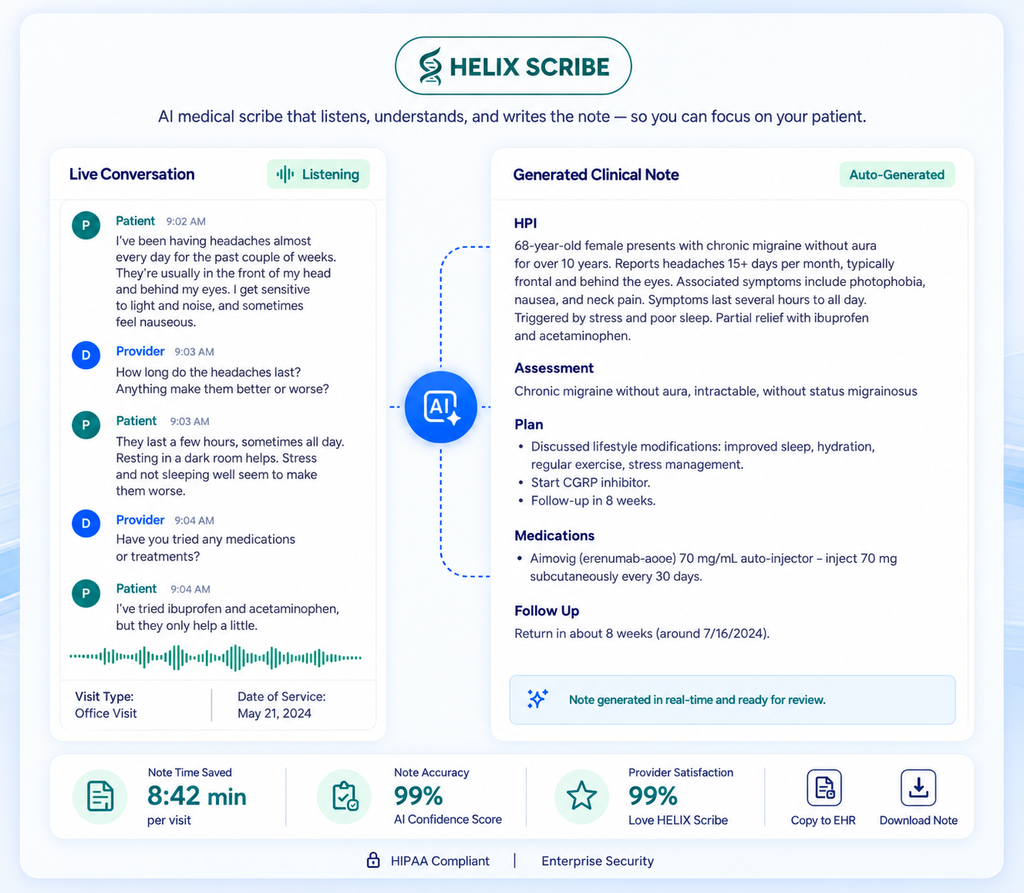
AllayAI HELIX brings AI-powered clinical documentation into a broader healthcare workflow platform.
HELIX Scribe uses AI to help transform supported patient-provider conversations into structured, specialty-aware clinical notes for clinician review.
Capabilities include:
- Ambient AI Scribing: Captures supported patient-provider conversations for documentation.
- Structured Clinical Notes: Organizes clinical information into sections such as history of present illness, assessment, plan, medications, and follow-up.
- Clinician Review: Prepares documentation for review before finalization.
- EHR Workflow Support: Supports documentation workflows connected with electronic health records.
Beyond scribing, HELIX brings together other healthcare capabilities, including medical translation, AI editing, workflow automation, coding, billing, and EHR-related workflows.
AllayAI HELIX is designed to support healthcare organizations’ privacy and security requirements. Organizations should review current security documentation, relevant agreements, and product-specific data-handling practices to determine whether the solution meets their compliance needs.
Learn more: Read our guide, HIPAA-Compliant AI Medical Scribe: What Healthcare Organizations Should Look For Before Choosing a Solution, for practical guidance on evaluating AI scribe features, privacy safeguards, and vendor requirements.
Common Mistakes to Avoid When Choosing an AI Medical Scribe
Choosing Based on Price Alone
A low subscription cost does not guarantee a suitable clinical workflow or appropriate data protection. Compare total costs, integrations, support, implementation, and the vendor’s safeguards.
Assuming AI-Generated Notes Are Always Accurate
AI systems can misinterpret speech, omit details, or produce incorrect information. Establish a clear process for clinicians to review and correct documentation.
Treating a BAA as Complete Compliance
A BAA is important when required, but it does not replace risk analysis, safeguards, policies, staff training, and other applicable responsibilities.
Overlooking Data Retention
Understand how audio, transcripts, notes, and logs are handled. Different data types may have different retention and deletion rules.
Ignoring EHR Compatibility
A tool that does not fit your existing EHR can introduce extra steps and manual work. Confirm integration compatibility and implementation requirements before signing a contract.
Relying Only on Marketing Claims
Ask for current documentation, contractual commitments, and a demonstration of relevant workflows. Verify security and compliance statements rather than treating them as independent proof.
Frequently Asked Questions
1. What is a HIPAA-compliant AI medical scribe?
It is an AI documentation solution evaluated for how it handles protected health information and supports applicable HIPAA obligations. Compliance depends on the service, the parties involved, the safeguards and agreements in place, and how the tool is used.
2. Does an AI medical scribe need a BAA?
A BAA is generally required when a vendor acts as a business associate and creates, receives, maintains, or transmits PHI on behalf of a covered entity or another business associate, subject to applicable HIPAA rules. Healthcare organizations should confirm the vendor’s role and contractual requirements.
3. Is encrypted AI scribe software automatically HIPAA-compliant?
No. Encryption is one safeguard, but HIPAA compliance involves broader requirements, including risk analysis, access management, policies, agreements, and other appropriate protections.
4. Can an AI medical scribe store patient conversations?
Data handling varies by product. Ask whether audio is recorded, whether transcripts are retained, how long information is stored, who can access it, and how deletion works. Review the vendor’s policies and relevant agreements before using patient information.
5. Do clinicians need to review AI-generated notes?
Clinician review is an important safeguard. Healthcare professionals should confirm that generated notes accurately reflect the encounter and correct missing or incorrect information before finalizing them.
6. What should a medical practice check before adopting an AI scribe?
Review the BAA where applicable, data handling, encryption, access controls, audit logs, retention policies, AI training practices, subcontractors, incident response, EHR compatibility, and clinical review workflows.
7. Can an AI medical scribe integrate with an existing EHR?
Some products support integration with existing EHR systems, but compatibility and available workflows vary. Confirm supported systems, data transfer methods, implementation requirements, and review controls with the vendor.
8. How does AllayAI HELIX differ from a standalone AI medical scribe?
AllayAI positions HELIX as a broader healthcare platform that connects AI scribing with capabilities such as medical translation, workflow automation, coding, billing, and EHR-related workflows. Review the specific features and integrations available to determine whether they fit your practice.
Conclusion
Choosing a HIPAA-compliant AI medical scribe requires more than comparing documentation features or relying on a vendor’s compliance statement. Healthcare organizations need to evaluate how patient information is handled, which safeguards are in place, whether appropriate agreements are available, and how the tool fits into clinical workflows.
Before making a decision, assess documentation quality, clinician review, data retention, access controls, vendor responsibilities, and EHR compatibility. Use official HHS guidance to inform your review and consult qualified privacy or compliance professionals about your organization’s specific obligations.
AllayAI HELIX combines AI-assisted clinical documentation with broader healthcare workflow capabilities. Explore HELIX Scribe to see how its documentation workflow may fit your practice.
Ready to Simplify Your Clinical Workflows?
See how AllayAI HELIX brings healthcare workflows together.
Book a DemoSources and References
- HHS: Guidance on HIPAA and Cloud Computing
- HHS: Business Associate Contracts
- HHS: Guidance on Security Risk Analysis
- HHS: Summary of the HIPAA Security Rule
- AllayAI HELIX Scribe: Official Product Information
- Google Search Central: Creating Helpful, Reliable, People-First Content
This article provides general information and is not legal advice. Healthcare organizations should consult qualified legal or compliance professionals about their specific HIPAA obligations.