The Prior Authorization Crisis: Why It’s Worse Than You Think and What AI Can Do About It

Prior Authorization AI in Healthcare | AllayAI

Prior authorization was designed as a cost-control mechanism. It gives payers a way to review the medical necessity of treatments before approving payment. What it has become is something different: a process that can delay care, consume physician time, and create administrative pressure for healthcare practices. In some cases, patients wait for treatments their physicians […]

What Physicians Actually Want from AI: Lessons from the Practices That Got It Right

AI-Powered Efficiency for Clinicians

The healthcare AI market is crowded with solutions to problems physicians did not ask to have solved. Diagnostic AI that promises to find cancer earlier, when the physician’s actual problem is finishing notes at midnight. Predictive analytics platforms that surface population health insights, when the physician’s actual problem is that prior authorization consumed 90 minutes […]

What Is Clinical Documentation Software? Benefits, Features, and Use Cases for Modern Healthcare Organizations

AI Clinical Documentation Software for Healthcare

Healthcare organizations generate thousands of clinical records every day. From patient encounters and treatment plans to referrals, follow-ups, care coordination, and compliance documentation, managing healthcare information has become increasingly complex. At the same time, physicians and healthcare staff continue to face growing documentation requirements. Studies show clinicians spend a significant portion of their day interacting […]

What Is an AI Agent for Healthcare? Use Cases, Benefits, and Real-World Applications

What Is an AI Agent for Healthcare? Use Cases, Benefits, and Real-World Applications Healthcare organizations are facing increasing pressure to support better patient outcomes while managing growing documentation requirements, staffing shortages, operational complexity, and rising administrative costs. Clinicians often spend hours each day completing documentation, coordinating care, managing referrals, reviewing records, and handling other repetitive tasks that reduce the time available for patient care. As healthcare leaders look for ways to improve efficiency without compromising quality, interest in the AI Agent for Healthcare continues to grow. AI agents represent the next evolution of healthcare automation by combining reasoning, memory, planning, and action capabilities into a single intelligent system designed to support healthcare workflows. Research suggests AI agents are evolving beyond traditional AI tools by helping healthcare organizations automate complex workflows, support clinical operations, and improve decision-making across healthcare environments. This guide explains how AI agents work, their core applications, benefits, major components, real-world healthcare use cases, and what healthcare organizations should evaluate before implementation. What Is an AI Agent for Healthcare? An AI Agent for Healthcare is an intelligent software system designed to perform tasks, process information, and support healthcare workflows with minimal manual intervention. Unlike basic automation tools that follow fixed rules, AI agents can analyze information, understand context, complete actions, and support healthcare teams across multiple operational and clinical processes. In healthcare environments, AI agents may assist with clinical documentation, patient communication, appointment management, care coordination, coding support, workflow automation, and administrative operations. The goal is not to replace healthcare professionals. The goal is to reduce administrative burden so clinicians and healthcare staff can focus more time on patient care. Quick Answer An AI Agent for Healthcare is an AI-powered system that helps healthcare organizations automate workflows, manage administrative tasks, support clinical documentation, coordinate care activities, and improve operational efficiency while maintaining clinician oversight. Did You Know? A recent peer-reviewed review published in the Journal of Biomedical Informatics analyzed more than 200 healthcare AI studies and found that modern healthcare AI agents are evolving beyond simple automation. The researchers identified key agent capabilities including reasoning, memory, planning, tool integration, and multi-agent collaboration, with applications across clinical documentation, clinical decision support, patient engagement, care coordination, and healthcare operations. Source of Information: PubMed: PubMed Article Journal Article: Journal of Biomedical Informatics Study Core Applications of AI Agents in Healthcare AI agents are being used across healthcare to support clinical, operational, and administrative workflows. Some of the most common applications include: Clinical Documentation: AI agents can capture patient conversations, generate structured clinical notes, summarize patient histories, and help clinicians reduce documentation burden while maintaining oversight. Clinical Decision Support: AI agents can help organize and surface relevant clinical information to support healthcare professionals in their decision-making while maintaining clinician oversight. Administrative Automation: Healthcare organizations use AI agents to automate repetitive tasks such as scheduling, referral management, prior authorizations, workflow coordination, and operational processes that often consume staff time. Patient Engagement: AI agents can support appointment reminders, patient intake processes, follow-up communication, care plan coordination, and patient education initiatives. Care Coordination: AI agents help streamline communication between providers, specialists, care managers, and patients, supporting smoother transitions across the care journey. Revenue Cycle Support: AI agents can assist with documentation review, coding-related workflows, claims preparation, billing processes, and other revenue cycle activities. Healthcare Operations Management: Healthcare leaders can use AI agents to support workflow monitoring, task management, operational reporting, and organizational efficiency initiatives. Medical Education and Training: AI agents are increasingly being explored to support healthcare education, clinical training programs, knowledge management, and professional development activities. Population Health and Analytics: AI agents can help healthcare organizations analyze trends, organize healthcare data, identify care gaps, and support population health initiatives. How Do AI Agents in Healthcare Work? AI agents operate through a combination of reasoning, memory, planning, and action capabilities. Unlike traditional software that follows fixed instructions, AI agents can evaluate information, determine next steps, and complete tasks based on context. A recent healthcare AI framework identifies four foundational components that support agent behavior: Component Function Planning Decision-making and task execution strategies Action Performing tasks and interacting with systems Reflection Interpreting and evaluating information Memory Storing and retrieving contextual information Together, these components allow AI agents to maintain context across workflows, process information from multiple sources, and support more intelligent healthcare automation. For example, an AI agent may capture patient information, organize documentation, coordinate follow-up activities, communicate with healthcare teams, and support workflow management within a single healthcare process. Components of AI Agents in Healthcare Modern healthcare AI agents typically include several key capabilities that support healthcare operations. Memory Memory allows AI agents to retain relevant information throughout a workflow. This helps maintain context across patient interactions, documentation processes, and operational activities. Planning and Reasoning Planning capabilities help AI agents evaluate information, identify goals, and determine appropriate actions. This enables support for more complex healthcare workflows rather than isolated tasks. Tool Integration Healthcare AI agents often connect with EHR systems, clinical documentation platforms, communication tools, and operational software to support workflow execution. Multi-Agent Collaboration Some advanced healthcare environments use multiple AI agents working together across different workflows. One agent may support documentation while another manages scheduling or care coordination. Benefits of AI Agents in Healthcare Healthcare organizations are increasingly evaluating AI agents because they offer benefits across clinical, operational, and administrative functions. Reduced Administrative Burden Administrative workload remains a major challenge across healthcare organizations. AI agents help automate repetitive processes, reducing the time spent on manual tasks. Improved Clinical Documentation AI agents can help organize patient information, support documentation workflows, and improve note consistency while maintaining clinician review and approval. Enhanced Care Coordination AI agents can help coordinate communication, referrals, follow-up activities, and patient engagement workflows across healthcare teams. Better Operational Efficiency By automating routine processes, healthcare organizations can improve productivity and support more efficient operations. Scalability Across Healthcare Organizations As organizations expand, AI agents can help support growing provider networks, specialties, departments, and patient populations while reducing the need for additional manual administrative work. Key Use Cases of AI Agents in Healthcare Clinical Documentation Automation One of the fastest-growing use cases involves AI-powered clinical documentation. AI agents can capture patient conversations, generate structured notes, and support clinician review processes. Patient Engagement Healthcare organizations use AI agents to support appointment reminders, follow-up communication, patient education, and engagement workflows. Care Coordination AI agents help manage care transitions, referrals, provider communication, and care management activities across healthcare teams. Healthcare Operations Management Healthcare administrators are increasingly using AI agents to support workflow management, operational coordination, and process automation. Clinical Decision Support Some AI agents assist healthcare professionals by organizing information and surfacing relevant clinical insights that support decision-making. Medical Education and Training Healthcare AI agents are also being explored for educational applications, training support, and clinical learning environments. Real-World Applications Across Healthcare Organizations Healthcare AI agents are moving beyond pilot programs and are increasingly being explored across hospitals, clinics, healthcare systems, research environments, and administrative operations. According to the study A Comprehensive Survey of AI Agents in Healthcare, researchers reviewed more than 200 healthcare AI studies and found growing adoption across clinicians, patients, administrators, researchers, and educators, highlighting the expanding role of AI agents throughout the healthcare ecosystem. Healthcare organizations are using AI agents in a variety of settings: Healthcare Setting AI Agent Application Hospitals Workflow coordination Primary Care Practices Documentation support Multi-Specialty Groups Administrative automation Specialty Clinics Care coordination Revenue Cycle Teams Workflow management Patient Access Teams Communication support Healthcare Systems Operational efficiency Hospitals Hospitals are exploring AI agents to support clinical documentation, care coordination, patient flow management, and operational workflows. By helping organize information and automate repetitive tasks, AI agents can assist healthcare teams in managing complex care environments more efficiently. Primary Care and Specialty Practices Primary care providers and specialty clinics are increasingly interested in AI agents that support documentation, patient communication, appointment coordination, and clinical workflow management. AI-powered assistants can help reduce administrative workload while allowing providers to focus more attention on patient care. Healthcare Administration Administrative teams are using AI agents to support scheduling, workflow coordination, reporting, resource management, and operational planning. These applications help healthcare organizations improve efficiency while reducing the burden associated with manual processes. Revenue Cycle and Financial Operations Healthcare organizations are also exploring AI agents for coding support, claims workflows, documentation review, and revenue cycle operations. When integrated with clinical documentation workflows, AI agents can help improve operational consistency and reduce administrative effort. Research and Medical Education Beyond patient care, AI agents are being evaluated for medical education, clinical training, healthcare research, and knowledge management. Researchers believe these systems may help healthcare professionals access information more efficiently and support ongoing learning initiatives. What Healthcare Leaders Should Evaluate Before implementing an AI Agent for Healthcare, organizations should evaluate: Workflow Integration: Fits within existing clinical workflows. Clinical Documentation Support: Improves documentation efficiency and quality. EHR Compatibility: Connects with existing healthcare systems. Security and Compliance: Supports HIPAA and data protection requirements. Scalability: Supports growth across providers and locations. Provider Adoption: Easy for clinicians and staff to use. Operational Support: Reliable implementation and ongoing support. Successful AI agent adoption starts with solving real workflow challenges while maintaining security, compliance, and clinician oversight. Why Healthcare Organizations Choose AllayAI HELIX AllayAI HELIX provides a connected healthcare platform designed to support documentation, workflow automation, communication, coding, billing, and operational efficiency. HELIX includes: HELIX Feature Purpose Scribe Ambient AI documentation Translator Real-time multilingual communication Patient Portal Patient engagement Editor Documentation review AI Agent Workflow automation Coding Coding workflow support Billing Revenue cycle workflows End-to-End EHR Connected healthcare operations By connecting clinical documentation, communication, coding, billing, and workflow automation, HELIX helps healthcare organizations reduce administrative burden while supporting patient care workflows. About AllayAI HELIX AllayAI HELIX is an AI-powered healthcare platform designed to support clinical documentation, workflow automation, translation, coding, billing, and connected healthcare operations. The platform helps healthcare organizations streamline workflows while supporting efficient and secure patient care processes. Conclusion AI agents are playing an increasingly important role in healthcare by helping organizations automate workflows, support greater efficiency, improve clinical documentation processes, and enhance operational performance. From care coordination and patient communication to workflow automation and healthcare operations, AI agents are becoming a critical part of modern healthcare technology strategies. As adoption continues to grow, healthcare organizations that successfully integrate AI agents into clinical and operational workflows may be better positioned to reduce administrative burden, improve efficiency, and support high-quality patient care. Research also suggests that future healthcare AI systems will become increasingly collaborative, context-aware, and capable of supporting more complex healthcare environments. Frequently Asked Questions What is an AI Agent for Healthcare? An AI Agent for Healthcare is an intelligent software system that helps automate clinical and administrative workflows, support decision-making, and improve operational efficiency across healthcare organizations. How do AI agents work in healthcare? AI agents analyze information, maintain context, identify tasks, and perform actions across healthcare workflows such as documentation, patient communication, care coordination, and operational management. What are the main benefits of AI agents in healthcare? AI agents help reduce administrative burden, improve workflow efficiency, support clinical documentation, enhance patient engagement, and streamline healthcare operations. Can AI agents support clinical documentation? Yes. AI agents can help capture patient information, generate structured clinical notes, organize documentation, and support provider review workflows. Are AI agents replacing healthcare professionals? No. AI agents are designed to assist clinicians and healthcare staff by automating repetitive tasks while maintaining human oversight and decision-making. Can AI agents integrate with EHR systems? Many healthcare AI platforms are designed to integrate with Electronic Health Record (EHR) systems to support existing clinical and operational workflows. What healthcare tasks can AI agents automate? AI agents can support documentation, patient communication, care coordination, scheduling, workflow management, coding support, billing workflows, and administrative operations. How do AI agents support patient care? AI Agent for HealthcareWhat should healthcare organizations evaluate before implementing an AI agent? Organizations should assess workflow integration, EHR compatibility, security controls, compliance requirements, scalability, provider adoption, and operational support before implementation. How does AllayAI HELIX support healthcare AI automation? AllayAI HELIX combines AI-powered documentation, workflow automation, translation, patient engagement, coding support, billing workflows, and connected healthcare operations within a single healthcare platform. Medical Disclaimer This content is for informational purposes only and should not be considered medical, legal, compliance, or professional advice. Healthcare organizations should evaluate solutions based on their specific clinical, operational, security, and regulatory requirements before implementation.

Healthcare organizations are facing increasing pressure to support better patient outcomes while managing growing documentation requirements, staffing shortages, operational complexity, and rising administrative costs. Clinicians often spend hours each day completing documentation, coordinating care, managing referrals, reviewing records, and handling other repetitive tasks that reduce the time available for patient care. As healthcare leaders look […]

The Real Cost of a Missed Code: How Documentation Gaps Drain Practice Revenue
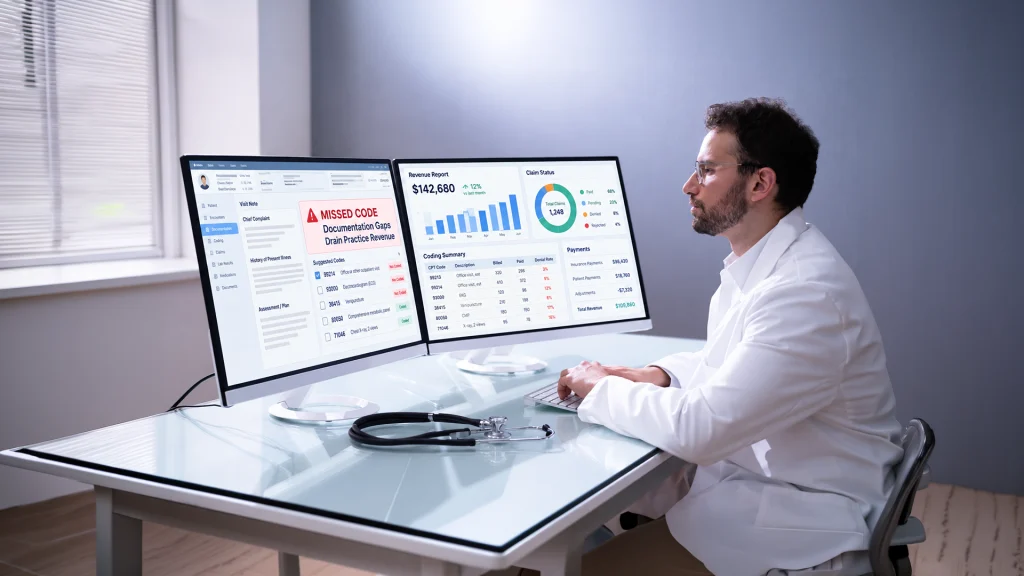
Physician reviewing patient data on multiple monitors

A physician sees a patient with Type 2 diabetes, CKD stage 3, and hypertension. All three conditions are active, documented in the chart, and actively managed at the visit. The note mentions all three. But only the hypertension appears in the structured diagnosis field the coder reads. The claim is submitted. The diabetes and the […]

Care in the Moment: How Ambient AI Helps Physicians Stay Present

Doctor talking with a patient in an exam room

There is a moment in every clinical visit when a patient says something important. A detail that changes the differential. A symptom mentioned almost as an afterthought. A fear they have been carrying for months and are only now voicing. Whether a physician catches that moment depends, more than most people realize, on where their […]

AI Healthcare Platform: How AI Is Transforming Healthcare Workflows for U.S. Physicians in 2026

Physician using a tablet with an AI interface

Healthcare has never been short on technology. Most medical practices already use electronic health records, patient portals, scheduling systems, billing platforms, and communication tools. The challenge is that these systems often operate independently, forcing physicians and staff to spend valuable time moving information between workflows instead of focusing on patient care. A physician may complete […]

Healthcare Workflow Automation: What It Actually Looks Like Inside a U.S. Medical Practice

Physician using a laptop and tablet at a desk

Walk into most U.S. medical practices on a Wednesday afternoon, and you’ll often find the same challenge happening behind the scenes. A nurse is entering patient information into multiple systems. Front-desk staff are verifying insurance eligibility while answering patient calls. Physicians are completing documentation long after clinic hours have ended. Billing teams are reviewing claims […]